Search Icon White

ANSI IMPACT REPORT 2025

HIGHLIGHTS OF PROGRESS ON KEY PRIORITIES FOR ANSI, WORKCRED, AND THE ANSI NATIONAL ACCREDITATION BOARD (ANAB)

A new era in American Standards Leadership

In January 2025, ANSI embarked on a new era of leadership for the U.S. standards community at home and abroad. Laurie E. Locascio, Ph.D. NAE, took the helm as ANSI president and CEO at a time of significant change. Technologies that barely existed five years ago now demand robust standards frameworks. Geopolitical competition is reshaping international standardization. Market access increasingly hinges on demonstrating conformance.

Working with members and partners across sectors, ANSI elevated America’s global profile, strengthened U.S. representation where the rules of the market are written, and reinforced standardization as essential infrastructure for the innovation economy.

“Those who shape standards shape the future — and increasingly, nations worldwide understand this power.”

— Dr. Laurie E. Locascio
Dr Laurie E Locascio

U.S. Standards Strategy: From vision to action

ANSI led the development of the United States Standards Strategy (USSS) 2025 — a major update reaffirming America’s commitment to private-sector-led standardization while responding to competitive pressures in emerging technologies, geopolitical dynamics, and international market access.

  • Defined four strategic objectives supporting U.S. competitiveness: strengthening U.S. international standards leadership, demonstrating the broad value of standards, making development more efficient, and addressing opportunities in emerging technologies.
  • Spearheaded informed implementation: Shaped by stakeholder input, ANSI prepared an implementation plan with actionable milestones in global engagement, emerging technology coordination, workforce development, and standards education.
  • Officially launching in January 2026, the strategy has already garnered broad positive feedback through ANSI’s extensive outreach and can serve as a guiding framework for the initiatives highlighted below and those planned for 2026.
USSS 2025

Global Leadership: America on the international stage

Across the globe, ANSI expanded strategic partnerships and strengthened U.S. leadership where international standards that shape markets are written.
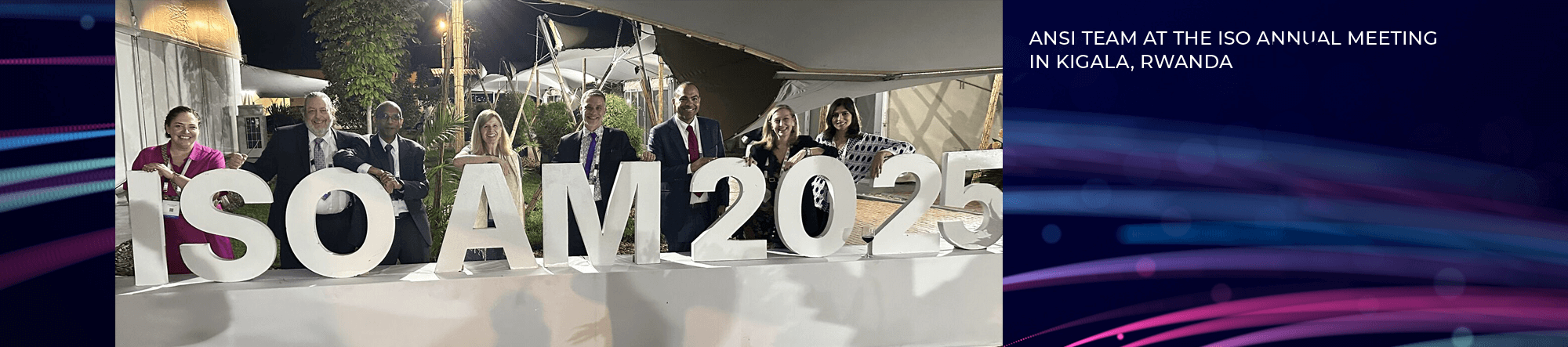
  • Fortified U.S. leadership in ISO/IEC JTC 1: At its meeting in Chengdu, China, the International Organization for Standardization and International Electrotechnical Commission Joint Technical Committee 1 on Information Technology (ISO/IEC JTC 1) appointed Laura Lindsay of Microsoft as JTC1 Chair-elect for 2026 and Chair for 2027-2029. This ensures continued U.S. leadership of the largest international technical committee—administered by ANSI, with 49 national bodies participating—using a globally-accepted consensus-based process in the development of more than 3,600 IT standards shaping every industry. 
“Standards are the rules of the market. If you meet the standard, you meet the market.”

—Dr. Ngozi Okonko-Iweala, Director-General of the World Trade Organization, at ISO General Assembly 2025
  • Influenced ISO policy and progress: At ISO leadership meetings in Geneva and Rwanda, ANSI advocated for ISO’s digital transformation and committed to actively participating in development of the joint ISO/IEC SMART program—to drive the digital evolution of international standards. 
  • Launched ISO-IEC Online Standards Development (OSD) hub: ANSI provided intensive training and resources for U.S. participants to effectively use the new harmonized platform for ISO and IEC standards contributors. Expanding ANSI’s direct role in this key initiative, Kristen Califra was selected for the ISO OSD Training Officer Fellowship to work closely with ISO on outreach and training for implementation of the platform across the ISO community.
  • Fostered U.S. capacity and impact in international standardization:
  • Filled key expertise gaps: ANSI launched the U.S. ISO Critical Minerals Standards Coordination Group (ICMSCG) to align stakeholders strategically on U.S. representation and influence in ISO standardization activities for critical minerals - among other efforts to maintain U.S. representation in high-stakes areas. 

ISO AM 2025

  • Expanded U.S. influence internationally through regional and bilateral cooperation:
All ISO IEC JTC1 Activity

Defending the U.S. System: Coordinated responses to critical challenges

As geopolitical, regulatory, and technological forces reshaped the standards ecosystem, ANSI safeguarded the private-sector-led, market-driven U.S. standardization model.

  • Defended essential copyright frameworks: ANSI released an updated action brief for standards developing organizations and convened members and legal experts to develop sustainable, balanced approaches to incorporation by reference challenges.
  • Spotlighted standards on the policy stage: At the widely attended “A U.S. Standards Strategy for the 21st Century," hosted by the Center for Strategic and International Studies and ANSI, Dr. Locascio emphasized standards as strategic assets that determine market access, shape innovation pathways, and influence global commerce.
  • Championed WTO standards principles: ANSI advocated for open, transparent standards systems under the World trade Organization (WTO) Agreement on Technical Barriers to Trade —countering state-driven alternatives that risk fragmenting global markets.
  • Shared policy insights: ANSI monitored federal activities such as deregulation, export controls, and AI governance and informed members via its Government Relations & Public Policy Monthly Update.
  • Supported international AI governance: ANSI leadership actively contributed to the development of ISO’s upcoming AI framework—a risk-based approach to responsible use of standards and AI.
CSIS video

Innovation Leadership: How Standards Power Progress

PSA
Through high-profile events, strategic partnerships, and online initiatives, ANSI demonstrated that standards form the invisible infrastructure enabling scalable, trustworthy innovation.
  • Held inaugural ANSI Innovation Summit, convening 370+ leaders from industry, academia, and policy forums to explore standards-enabled innovation for emerging technologies and common priorities. Among the events:
    • Manufacturing Revolution Conference: Focused on the gap between AI pilots and scaled deployment, highlighting how standards reduce risk and accelerate adoption in smart manufacturing.
    • Standards Power Progress Showcase: Live demos brought standards to life, showing their role in safety, trust, and cross-sector interoperability.
    • Legal Issues Forum: Explored how AI, deregulation, and copyright frameworks are impacting standardization.
  • Accelerated emerging tech: As an implementing partner of the ASCET Center of Excellence, ANSI supported the first ASCET workshop to help shape the future of standardization for AI, quantum systems, biotech, and semiconductors.
  • Delivered measurable progress in critical technologies: ANSI standards collaboratives addressed 200 gaps where standardization work was initiated or completed  30 of 37 in electric vehicles, 104 of 141 in additive manufacturing, and 66 of 71 in unmanned aircraft systems.
Innovation Summit
  • Launched ANSI Compliance Solutions: The new cloud-based platform enables organizations to track and manage multi-jurisdiction conformity requirements-directly supporting market access through standards compliance.

Member Engagement: Expanding the Community

ANSI strengthened and broadened our membership community through listening, responsive programming, and expanded educational offerings.

  • Launched Technology Consortium Council: This new Council provides a forum for discussion and networking among senior leadership of consortia and a mechanism to engage and collaborate with ANSI and formal standards developing organizations.
  • Enhanced resources for executives: Expanded Standards Boost Business case studies and video testimonials, strengthening the message on the business value of standards and the benefits of participating in their development.
  • Listened and responded to member needs: Listening tours, live polling at events, targeted newsletters, and a resource roundup addressed member needs around priorities like AI, deregulation, IBR, and global engagement.
  • Strengthened consumer participation: Expanded funding to cover fees for participation in U.S. Technical Advisory Groups to enable consumer input to U.S. positions on draft standards under consideration by ISO and IEC, and enhanced the Consumer Safety Central webinar series.
Membership

For more on the impact of ANSI’s 2025 activities, explore ANSI online news.

Workcred: Strengthening Tomorrow's Workforce

In 2025, Workcred advanced clarity, quality, and alignment in the U.S. credentialing ecosystem—strengthening the connection between credentials and real-world requirements across industry, education, and standards.

  • Integrating certifications into associate degrees: With the Higher Learning Commission and the League for Innovation in Community College, Workcred released resources helping community colleges align education with skills-based hiring for living-wage careers.
  • Presented certification-plus-degree (C+D) pathways at the League for Innovation conference: Demonstrated how C+D pathways can support first-generation, low-income, and adult learners, strengthening workforce quality.
  • Earned grant to study non-degree credential attainment among college graduates: In collaboration with Strada Education Foundation, Workcred is conducting a national analysis of how these learning pathways shape student outcomes and workforce readiness.
  • Workcred and UT System highlighted microcredential integration: Released case studies showing how faculty are embedding microcredentials into undergraduate curricula, transforming education to align with evolving workforce needs.
  • Highlighted credentials keeping pace with business: Through events and micro-chats, Workcred showcased how non-degree credentials are evolving to meet employer needs, helping colleges and manufacturers integrate certifications into programs and prepare for the AI-driven workforce.

Workcred UT Case Studies

For more on the impact of workcred's 2025 activities, explore workcred.org.

ANAB: Digital Solutions, Expanded Reach

In 2025, ANAB accelerated its digital transformation, expanded cross-border accreditation pathways, and strengthened trust in AI and safety-critical technologies.
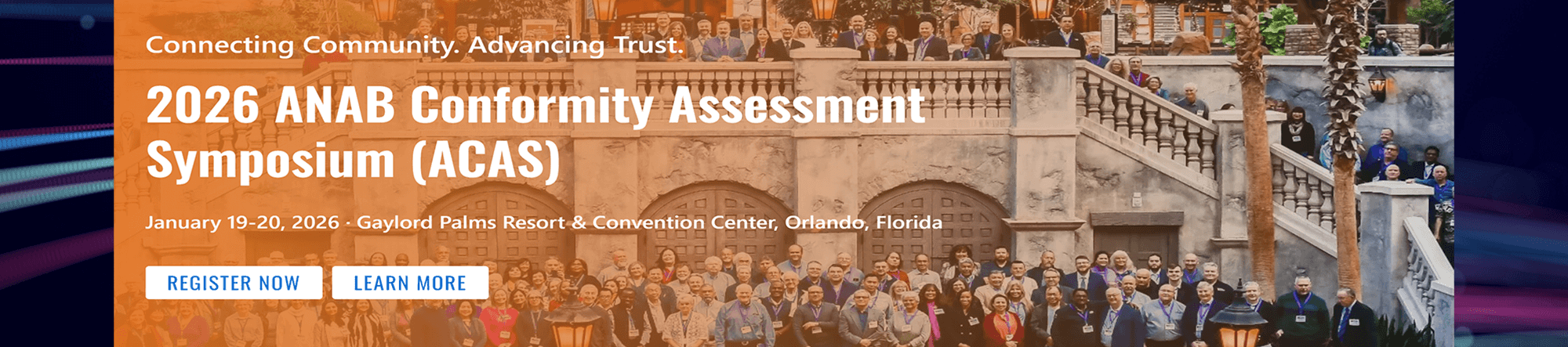
  • Shaping the future: Announced its January 2026 Conformity Assessment Symposium to explore how AI is transforming conformity assessment practices, bridge between global market approaches, and other pressing challenges.
  • Launched Digital Technology Initiative: Kicked off ANAB's digital transformation with the creation of an AI Task Force. The goal is to modernize accreditation processes through harmonized service delivery, continuous monitoring, digital workflows, and predictive analytics.
  • Established ANAB-CALA collaborative accreditation: The strategic partnership with Canadian Association for Laboratory Accreditation (CALA) offers a path for ISO/IEC 17025 accreditation in both the U.S. and Canada with coordinated assessments and reduced administrative burden.
  • Expanded AI accreditation: Increased NVIDIA’s Halos AI Systems Inspection Lab scope to cover industrial, robotic, and agricultural applications—helping assure AI-driven tools are assessed using rigorous standards.
  • Advanced accreditation training: Trained over 1,400 professionals through 99 public courses, 28 private sessions, and 61 self-paced offerings, equipping the conformity assessment community with expertise in standards implementation and assessment practices.
  • Strengthened recognition in high-stakes sectors: Expanded IAF multilateral recognition for aerospace quality management systems and renewed agreement with American Board of Forensic Toxicology for forensic laboratory accreditation.
  • Launched Audeee portal: Introduced unified system bringing staff, clients, and assessors into one streamlined software platform, centralizing information collection and management throughout the accreditation process for improved communication, organization, and service delivery.

ANAB Symposium

For more on the impact of ANAB’s 2025 activities, explore ANAB news.

View Annual Reports Archive